






Sierra Leone Government Warns Petroleum Dealers Over Fuel Price Fixing
Introduction
The Government of Sierra Leone, through the National Petroleum Regulatory Authority (NPRA), has issued a strong warning to petroleum dealers following the sudden and uniform adjustment of pump prices to NLe 28.5 across the country. Authorities described the development as potential cartel behaviour and a coordinated attempt to exploit consumers, noting that such practices are illegal under the NPRA Act 2025.
 NPRA Raises Concern Over Uniform Fuel Pricing
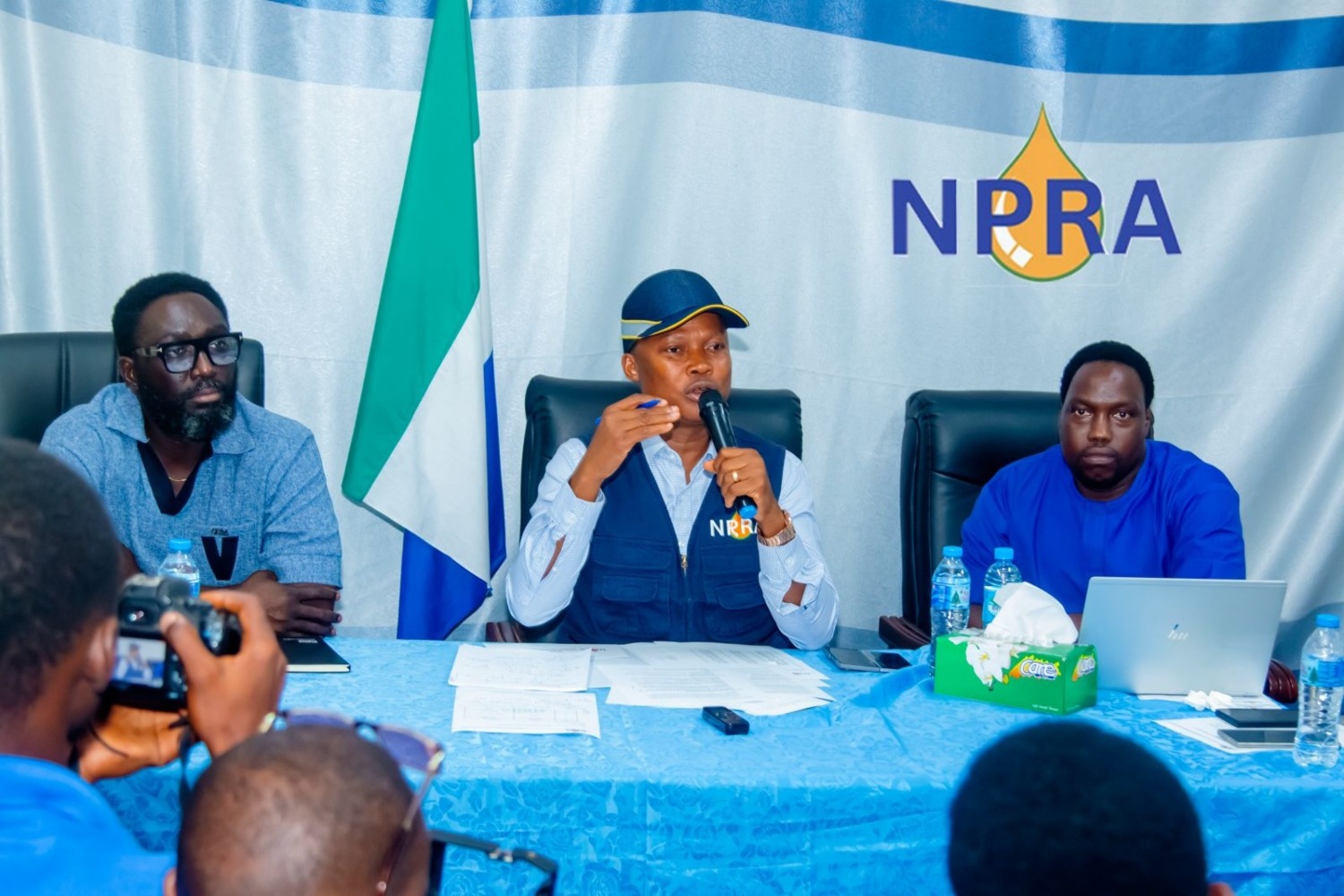
Speaking at a press conference held at the NPRA Headquarters on A.J. Momoh Drive, Tower Hill in Freetown, the Director General, Mr. Brima Baluwa Koroma, expressed concern over the overnight alignment of prices. He clarified that while the government recently adjusted the ceiling price from NLe 27.4 to NLe 28.5, dealers are permitted to sell below the ceiling and not necessarily at the maximum figure.
According to him, the ceiling price serves as a market guide rather than a fixed retail instruction. Using it as justification for excessive mark-ups, he said, undermines consumer protection and fair competition.
 New Pricing Formula and Market Diversity
The NPRA explained that a new pricing formula has been introduced to ensure transparency within the petroleum downstream sector. Since 2018, the number of registered dealers has increased significantly, with suppliers importing fuel from multiple countries including Spain, France, Senegal and Lomé.
Because shipping routes and operational costs differ, natural price variations are expected in the market. The sudden uniformity of pump prices, therefore, raised concerns of possible tacit collusion among dealers.
 Legal Position Under the NPRA Act 2025
The NPRA Act 2025 explicitly prohibits price fixing and cartelisation. Section 54 of the Act makes it illegal for operators to collaborate in ways that restrict competition or manipulate retail prices.
The Authority has warned that any coordinated attempt to maximise profits at the expense of consumers will attract enforcement actions and sanctions as provided by law.
 Monitoring and Enforcement Measures
To ensure compliance, the NPRA has pledged to station monitoring teams at fuel terminals to verify invoices and pricing structures. The Authority emphasised that storage challenges are no longer a constraint within the sector and reassured the public that consumers must receive fair value for money.
Officials also noted that although the government’s adjustment of the ceiling price was modest and reflective of global market trends, dealers who increased prices excessively were acting in bad faith.
 Growth and Transformation of the Petroleum Sector
Since 2018, the petroleum downstream industry has experienced considerable reforms aimed at dismantling monopolies and encouraging new market entrants. Companies such as Zala, Aminata, Eco Energy and Malador have joined the sector, increasing competition and improving service delivery.
The industry has also become a dependable source of domestic revenue for the National Revenue Authority (NRA), contributing significantly to national economic development.
 Government Commitment to Fair Competition
President Dr. Julius Maada Bio has consistently highlighted the petroleum sector as a critical component of Sierra Leone’s economy. During engagements with oil marketing companies, he reaffirmed government commitment to dialogue, private-sector collaboration and consumer protection.
The government maintains that the sector must remain open, competitive and law-guided, urging dealers to comply with the NPRA Act 2025 and operate fairly.
 Conclusion
The government’s firm stance against price fixing reflects its broader objective of transparency, accountability and consumer protection within Sierra Leone’s petroleum industry. Authorities have pledged continued monitoring, strict enforcement and public engagement to ensure that reforms in the sector remain aligned with national development goals.